
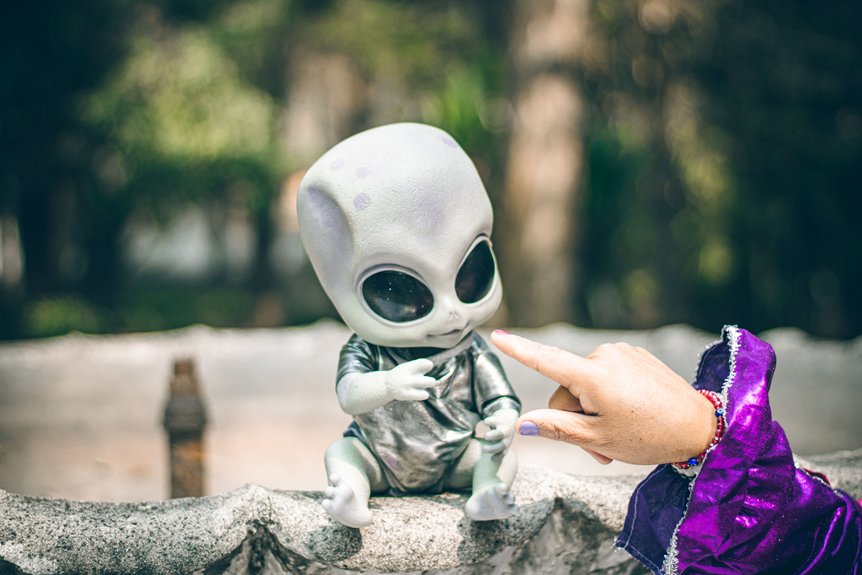
Imagine a small, grey figure with large, black eyes staring back at you from the shadows of a starry night. The debate over the existence of Grey aliens has fascinated many, drawing on a mix of eyewitness accounts and psychological theories. As you explore the evidence and implications, you’ll find that the conversation extends beyond mere belief, touching on deeper questions about humanity and our place in the cosmos. What might this mean for our understanding of reality?
Are Grey Aliens Real? The Origins and Impact?
Are Grey aliens real, or are they simply a product of our imagination? The origins of the Grey alien phenomenon trace back to the mid-20th century, particularly after the 1947 Roswell incident.
Are Grey aliens a reality or merely a figment of our collective imagination, stemming from the pivotal Roswell incident of 1947?
Witness accounts and popular media began to shape public perception, creating a narrative that intertwined extraterrestrial life with human experience. This phenomenon reflects cultural anxieties and the human desire to explore the unknown.
The impact of these beliefs is significant; they influence popular culture, science fiction, and even scientific inquiry into extraterrestrial life.
While some individuals firmly believe in their existence based on personal experiences, skeptics argue that psychological and sociocultural factors primarily shape these encounters.
Ultimately, the question remains open, inviting further exploration and debate.
Key Characteristics of Grey Aliens
Grey aliens, often depicted in popular culture, exhibit several distinctive characteristics that contribute to their enigmatic reputation.
Typically, you’ll notice their small stature, often described as around four to five feet tall. Their skin is usually depicted as smooth and gray, lacking any discernible texture. You might also observe their large, almond-shaped black eyes, which are said to be devoid of emotion.
Another key feature is their bulbous heads, which seem disproportionate to their bodies. Reports often describe them as having minimal facial features, such as small mouths and noses. Their movements are frequently depicted as smooth and deliberate, adding to their mysterious aura.
These traits form the basis of the Grey alien archetype in UFO lore and popular media.
Notable Grey Alien Abduction Cases
Numerous accounts of alien abductions feature Grey aliens, making them central figures in these unsettling narratives. You might find it intriguing to explore some notable cases that have shaped public perception.
| Case Name | Year |
|---|---|
| Betty and Barney Hill | 1961 |
| Travis Walton | 1975 |
| Kelly Cahill | 1993 |
| Antonio Villas Boas | 1957 |
| Steven Michalak | 1967 |
These cases often share themes of missing time, strange markings, and detailed descriptions of the Grey aliens. Each incident contributes to the ongoing discussion about the existence of these beings, raising questions about their intentions and the experiences of those involved.
Why Do We See Grey Aliens? Psychological Explanations?
What drives people to report encounters with Grey aliens? Several psychological factors might explain these experiences. Here are four key reasons:
- Sleep Paralysis: Many encounter reports coincide with episodes of sleep paralysis, where individuals experience hallucinations and an inability to move.
- Cultural Influence: Movies and media portrayals of Grey aliens can shape perceptions, leading individuals to interpret ambiguous experiences in line with these narratives.
- Memory Distortion: The mind can create false memories, especially under stress or trauma, influencing how individuals recall experiences.
- Collective Hysteria: Shared beliefs within communities can amplify personal experiences, prompting individuals to report similar encounters.
These factors suggest that psychological explanations play a significant role in the prevalence of Grey alien sightings.
Scientific Views on Grey Aliens
How do scientists approach the phenomenon of Grey aliens? Most scientists remain skeptical, emphasizing the lack of empirical evidence. They often categorize reports of Grey aliens as anecdotal, relying on psychological and sociocultural explanations rather than extraterrestrial origins.
Researchers explore how sleep paralysis, hallucinations, and cultural influences shape these experiences. They also highlight the role of the media in propagating the Grey alien narrative, leading to a collective belief that may not reflect reality.
In addition, scientists stress the importance of rigorous methodology in investigating UFO sightings and alien encounters. While some advocate for open-mindedness regarding the universe’s mysteries, the prevailing scientific stance is that Grey aliens, as popularly depicted, lack substantiation in credible research or observation.
How Media Influences Our Perception of Grey Aliens
The portrayal of Grey aliens in popular culture shapes public perception considerably, often overshadowing scientific skepticism. You encounter these extraterrestrials in various media, leading to a set of beliefs that may not align with reality.
Here are four ways media influences your views on Grey aliens:
- Visual Representation: Films and TV shows often depict Greys with large heads and big eyes, creating a lasting image.
- Narrative Tropes: Themes of abduction and invasion reinforce fear and curiosity.
- Celebrity Endorsements: Public figures discussing alien encounters lend credibility to these beliefs.
- Social Media: Viral videos and memes can amplify myths, making them seem more plausible.
These elements combine to create a narrative that shapes your understanding of Grey aliens, often blurring the line between fact and fiction.
Cultural Perspectives on Grey Aliens
Why do cultural perspectives on Grey aliens vary so widely across different societies? These differences stem from historical, social, and religious contexts shaping beliefs. For example, Western cultures often view Grey aliens as potential threats, while some Indigenous cultures see them as spiritual beings. This table highlights key cultural attitudes towards Grey aliens:
| Culture | Perspective | Notable Influence |
|---|---|---|
| Western | Threatening figures | Sci-fi media |
| Indigenous | Spiritual beings | Folklore and mythology |
| Asian | Curiosity and caution | Technology and science |
| African | Ancestors or spirits | Traditional beliefs |
Understanding these varying perspectives can deepen your insight into how cultural narratives shape our interpretations of the unknown, including Grey aliens.
Debunking Common Myths About Grey Aliens
Cultural narratives around Grey aliens often fuel misconceptions that can distort understanding of their significance. Many myths persist, leading to confusion about their nature. Here are four common misconceptions:
- They’re all malevolent: Many portrayals depict Grey aliens as hostile, but there’s no concrete evidence to support this.
- They’re responsible for abductions: While numerous abduction stories exist, they often lack verifiable evidence and can be explained through psychological phenomena.
- They’re extraterrestrial beings: Some theories suggest they could be interdimensional or even advanced AI rather than aliens from another planet.
- They have a universal agenda: The idea that all Grey aliens share a singular motive is simplistic; motivations can vary widely, if they exist at all.
Understanding these myths helps clarify the complexities surrounding Grey aliens.
The Future of Grey Alien Research
As researchers explore deeper into the phenomena surrounding Grey aliens, new methodologies and technologies are emerging to enhance our understanding.
Advanced AI algorithms and machine learning are now analyzing vast data sets from sightings and abduction reports, allowing for more nuanced patterns to emerge.
Additionally, interdisciplinary approaches combining psychology, astrophysics, and anthropology are enriching the discourse, providing diverse perspectives on the Grey alien narrative.
Virtual reality simulations are also being utilized to recreate alleged encounters, offering researchers a tool to study human reactions in controlled environments.
As these innovations progress, you’ll likely see a shift toward more empirical studies, which could either validate or debunk longstanding beliefs about Grey aliens, ultimately shaping future research directions in this intriguing field.
What If Grey Aliens Are Real? Implications for Humanity?
The possibility of Grey aliens being real raises profound questions about humanity’s place in the universe. If they exist, consider the potential implications for you and society:
- Technological Advancements: Interaction could lead to groundbreaking technologies that improve life on Earth.
- Philosophical Shifts: You might reevaluate beliefs about life, intelligence, and consciousness, expanding your understanding of existence.
- Global Unity: The realization that you’re not alone could foster international cooperation, uniting humanity against a common unknown.
- Ethical Dilemmas: Encountering an advanced species would challenge your moral frameworks, prompting discussions on rights and responsibilities toward other sentient beings.
These scenarios highlight how the existence of Grey aliens could reshape your worldview and societal structures, urging a deeper exploration of our collective identity.